A Structural Framework for Attraction, Perception and Relationships
Essence of Love is not a collection of romantic slogans. It is a structured framework for understanding why human connections emerge, intensify, stabilize or drift apart.
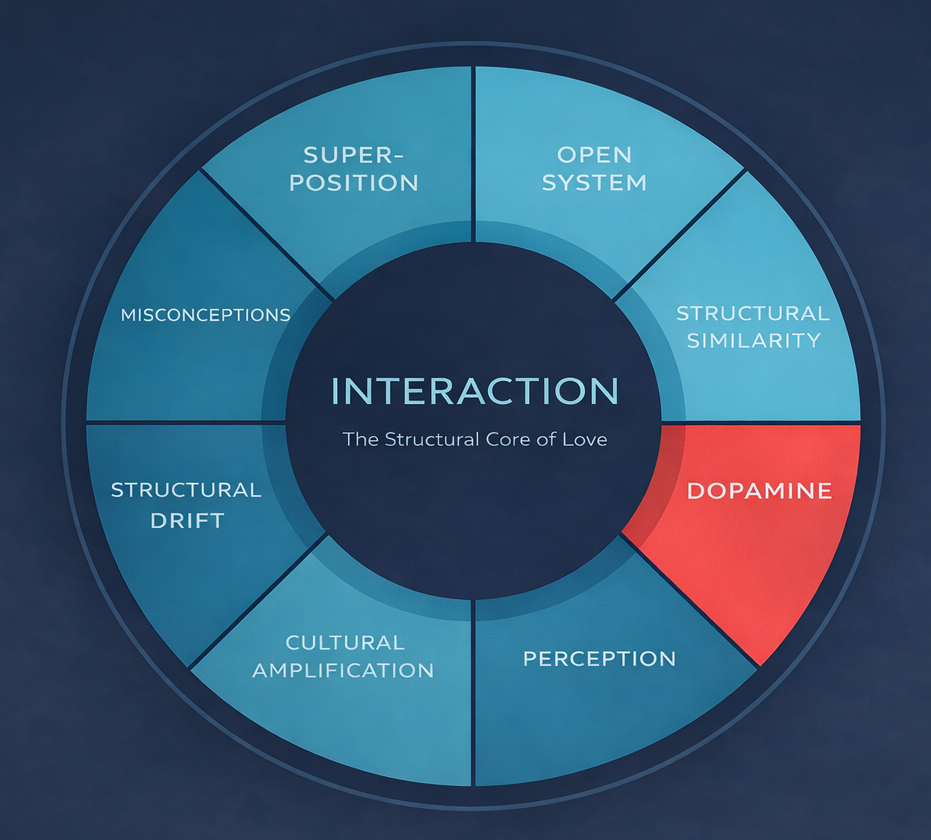
Instead of reducing love to chemistry, destiny or emotion alone, this framework looks at the interaction of multiple relational layers: personal structure, biological activation, direct interaction, environmental context and cultural amplification.
Each part of the series isolates one structural dimension and makes it visible. Together, the series shows that attraction is not random, perception is not neutral, and stable relationships do not emerge from intensity alone.
1️⃣ SUPERPOSITION
You Were Never “Just in Love”
2️⃣ OPEN SYSTEMS
Why No Relationship Leaves You the Same
3️⃣ STRUCTURAL SIMILARITY
Why Attraction Is Selective, Not Universal
4️⃣ DOPAMINE
Why Intensity Feels Like Destiny
5️⃣ PERCEPTION
Why You Often Fall for an Image
6️⃣ CULTURAL AMPLIFICATION
Why Media Shapes Who You Think You Love
7️⃣ STRUCTURAL DRIFT
Why Some Relationships Fade Without Conflict
8️⃣ MISCONCEPTIONS
The Most Common Mistakes About Love
Between Perception and Structure
At this point, one crucial question emerges.
If appearance, emotion, and context can all be similar,
what exactly do we recognize in a relationship?
What makes one person feel irreplaceable — even when everything else looks the same?
Twin Recognition Experiment
Imagine two identical twin sisters.
Same DNA.
Same upbringing.
Nearly identical appearance.
Yet one of them builds a relationship with you.
The other does not.
Now both stand in front of you.
Silent.
Identical.
And you are asked one question:
Which one is your partner?
You would recognize her almost instantly.
Not because of appearance.
But because of interaction.
Because of a pattern built over time.
9️⃣ THE STRUCTURAL MODEL
When Structure Becomes Visible
The previous perspectives describe individual mechanisms.
But relationships do not operate in isolation.
They operate as systems.
A relationship is not one factor.
It is the interaction of layers:
personal structure
biological activation
interaction patterns
environmental context
amplification
When these layers align,
we experience coherence.
What we call love.
Closing Frame
If love were random, stability would be random too.
It isn’t.
Relationships stabilize where structure becomes coherent.
Where interaction aligns across layers.
Where resonance is not accidental — but structural.
— Essence of Love