A YourLoveCode case context on partner selection, media exposure and structural resonance.
This page is not about proving a relationship through analysis.
It is about showing how analysis, image, media exposure and lived context
may overlap in the way relationships are perceived.
In contemporary culture, the image of a person can be repeated thousands
of times until it becomes stronger than the person’s actual relational structure.
What we call attraction, type, charisma or destiny may often be an overlay
of biology, narrative, projection and exposure.
YourLoveCode does not remove the narrative. It makes the layers visible.
How to read this page
This page should be read as a case context, not as a claim of prediction.
The analysis results shown here do not prove a relationship and do not guarantee any outcome.
They are one layer among others: image, time, environment, narrative,
personal history and exposure.
The purpose is to show how these layers may interact — and why relationships
should not be reduced to either numbers or stories.
Part I — Originator / co-creator and fair-play context
The originator / co-creator appears here not as the center of the project,
but as part of its fair-play context.
YourLoveCode did not emerge from an abstract theory alone.
It developed through observation, comparison, reflection and repeated attempts
to understand why some relationships stabilize while others do not.
The original texts in this section remain important because they show the human
and methodological starting point of the project.
Context and limits of the tool
How the idea of YourLoveCode emerged
YourLoveCode emerged as a result of long-term observation of human relationships,
their dynamics, recurring patterns, and the discrepancy between how relationships
are culturally represented and how they function in reality.
The starting point was not the intention to create a theory or a product,
but the need to understand the mechanism responsible for why some
relationships stabilize over time while others—despite intensity and involvement—fall apart.
The project developed gradually by combining personal observations with systemic analysis
and by testing hypotheses in practice.
What the basic analysis and premium analysis are
The basic analysis and the premium analysis in YourLoveCode are diagnostic tools
whose purpose is to identify areas of similarity and potential synchronization between individuals.
The analysis is not intended to predict relationships or to make decisions on behalf of the user.
Its function is structural description, encompassing, among other things,
biological, cognitive, emotional, energetic, and structural aspects.
The premium analysis broadens the scope of observation but
does not change the nature of the tool—it remains interpretative support,
not a predictive instrument.
What the YourLoveCode analysis does not do
The YourLoveCode analysis:
does not guarantee a relationship,
is not the cause of contact,
does not make decisions for the user,
does not replace life dynamics, environment, or time.
It is a descriptive tool, not a causal one.
Transition
The proper meaning of analysis results does not arise from numbers or descriptions alone.
It emerges only in the context of the overlaying of multiple layers:
similarity, environment, narrative, life stage, and exposure.
This perspective constitutes the content of the second part of the page.
What the results show — and what they do not show
The results presented on this page should not be read as a final answer.
They show possible areas of structural resonance, similarity and synchronization.
They do not explain the whole relationship, and they do not replace lived context.
In the YourLoveCode framework, a result is not a verdict.
It is a layer of interpretation.
Image and media as overlay
Media can change the way a person is perceived.
When an image is repeated hundreds, thousands or even tens of thousands of times,
it begins to function as a separate layer.
The person is no longer perceived only through direct contact, but through visibility,
style, social meaning, projection and public narrative.
This does not make the image false.
But it can make the image stronger than the mechanism underneath.
For YourLoveCode, this is one of the central questions of modern partner selection:
what happens when biological resonance is read through a field of images?
Part II — Narrative, image and analysis in practice
Narrative is not outside the analysis.
It is one of the layers through which relationships are understood,
remembered and interpreted.
In this sense, the originator / co-creator context is not only biographical.
It becomes an example of how personal history, image, environment, contact,
timing and analysis may overlap.
This is why the second part of the page should not be read as a simple
presentation of results.
It should be read as an example of superposition in practice: analysis results,
media-shaped perception, social context, personal narrative and relational dynamics
appearing at the same time.
Narrative is not the problem.
The problem begins when narrative is mistaken for mechanism.
Interpreting results in the context of overlaying (superposition)
Analysis results and the mechanism of overlaying
The results of the basic and premium analyses are not the cause of a relationship,
nor are they its guarantee.
From the perspective of YourLoveCode, they should be understood as
one of the layers that overlap in real life:
biological and cognitive similarity,
social and professional environment,
narrative and aesthetics,
life stage,
exposure and frequency of contact.
This phenomenon is referred to as superposition—in a systemic, not symbolic, sense.
Interpreting results in practice
Analysis results should be read not as an answer to the question “will a relationship happen,”
but as information about potential structural resonance, which may be strengthened
or weakened by other layers of the system.
Results involving the women from points 3 and 4 – the role of environment and narrative
In the case of results obtained with the women from points 3 and 4,
it is crucial to distinguish between the analysis result
and the dynamics of contact.
Both individuals operated within the fashion industry and, at different periods,
achieved a certain level of success in their respective environments. This implies
the presence of an additional layer of environmental superposition—aesthetic,
social, and narrative.
From the perspective of YourLoveCode, this does not constitute evidence of relational effectiveness,
but rather an example of how the overlaying mechanism operates,
in which the analysis is one element of a broader whole, not its cause.
Limits and responsibility of interpretation
YourLoveCode offers no promises and no simplified conclusions.
Its aim is responsible explanation of the mechanism,
not the reinforcement of illusions of control over relationships.
Analysis examples
The following examples should be read within this broader frame.
They do not show destiny, certainty or proof.
They show how selected analysis results may become meaningful only when read
together with context, exposure, narrative and time.
Example 1: 15-year relationship — visual summary of analysis results.
Click the image to view it in a larger size.
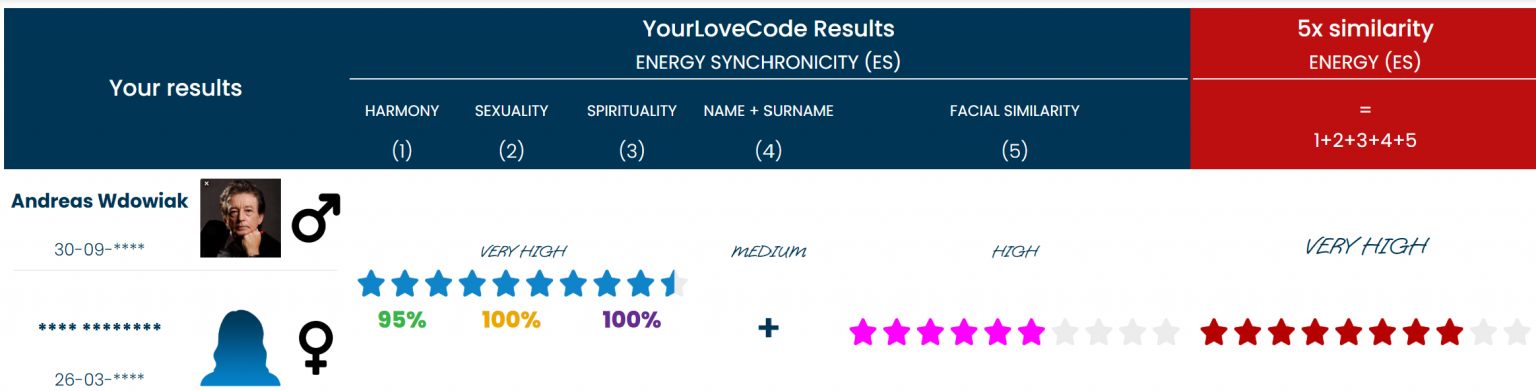
Example 2: 7-year relationship — visual summary of analysis results.
Click the image to view it in a larger size.
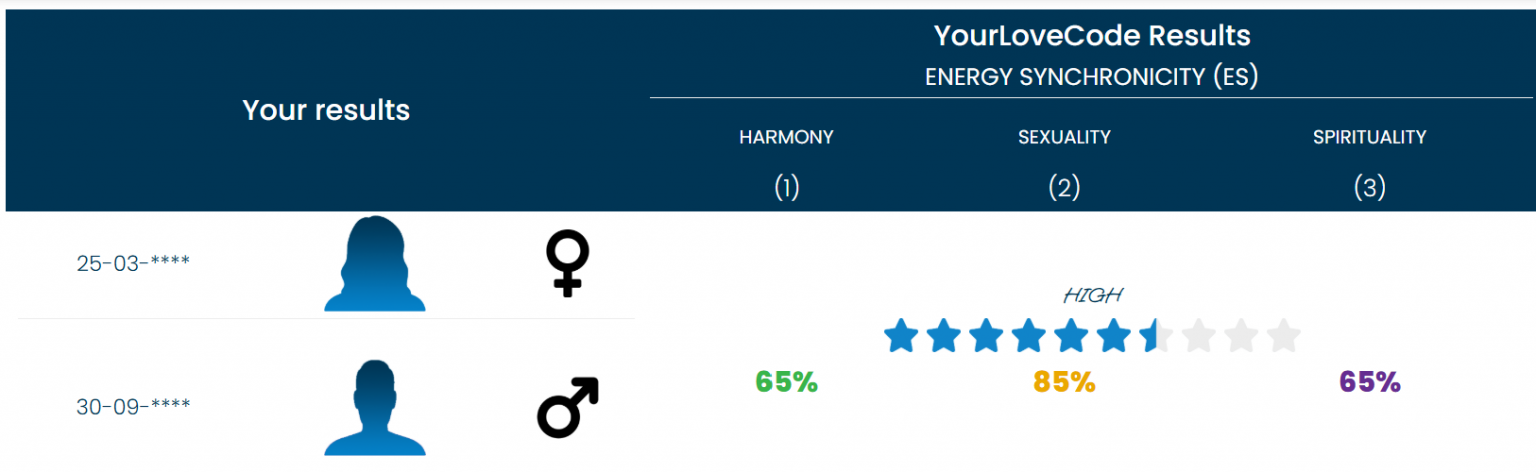
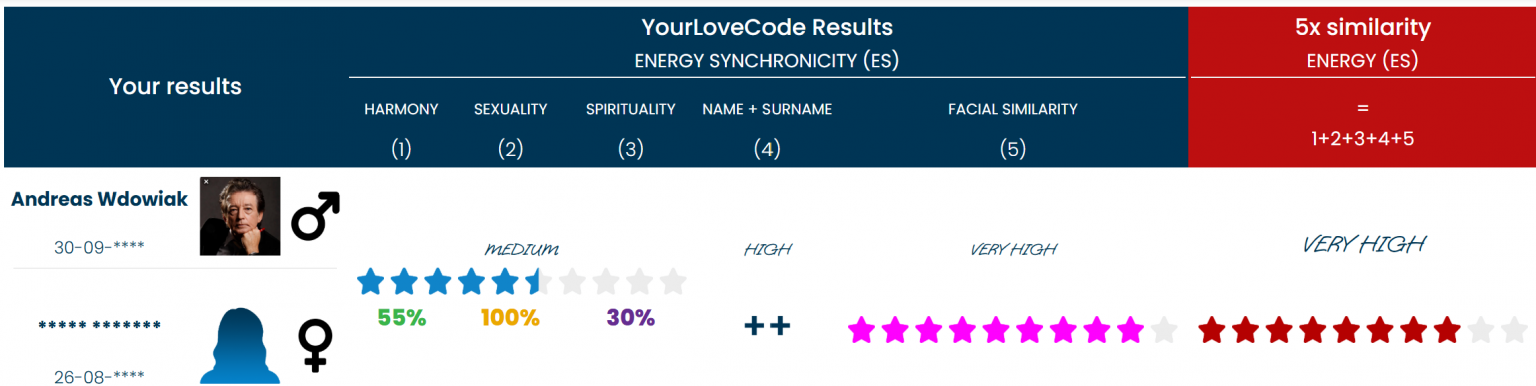
Example 3: 7-year infatuation — visual summary including 5× similarity components.
Click the image to view it in a larger size.
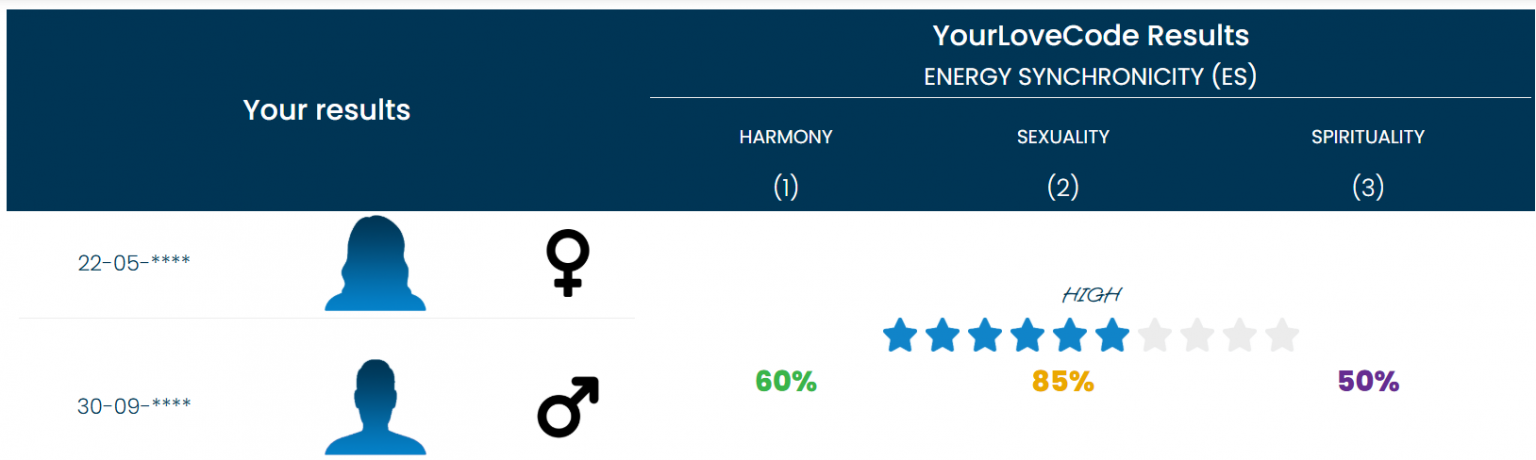
Example 4: A date — visual summary including 5× similarity components.
Click the image to view it in a larger size.
Superposition in practice
In the examples involving the women from points 3 and 4,
the analysis result is only one layer.
Both individuals were connected to the fashion world and, at different moments,
achieved visibility or success within their environments.
This creates an additional layer of environmental superposition:
aesthetics, social recognition, image, projection and narrative.
From the YourLoveCode perspective, this does not prove relational effectiveness.
It shows how the mechanism of overlay may operate when analysis,
image, environment and lived contact meet.
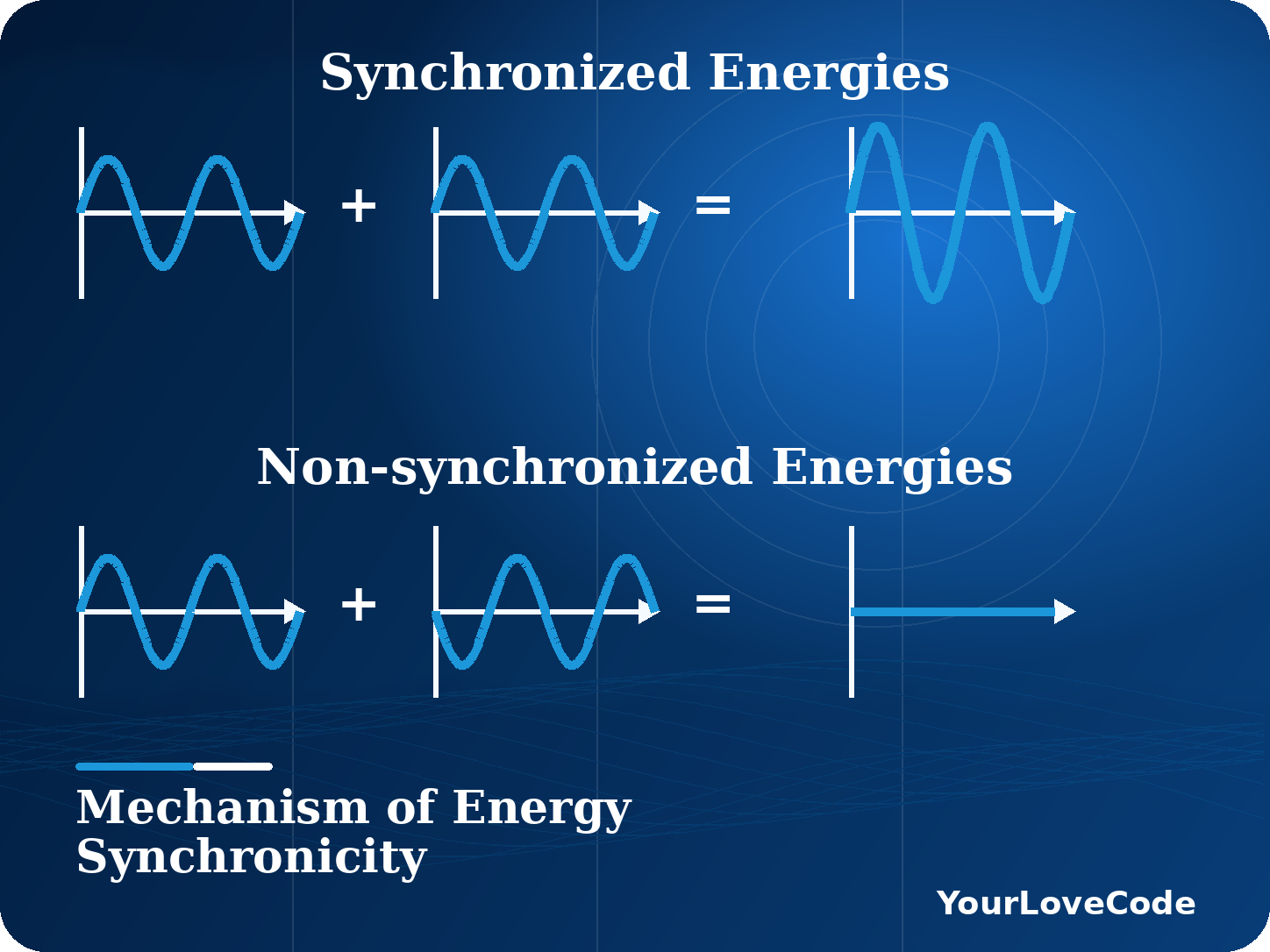
Mechanism of Energy Synchronicity
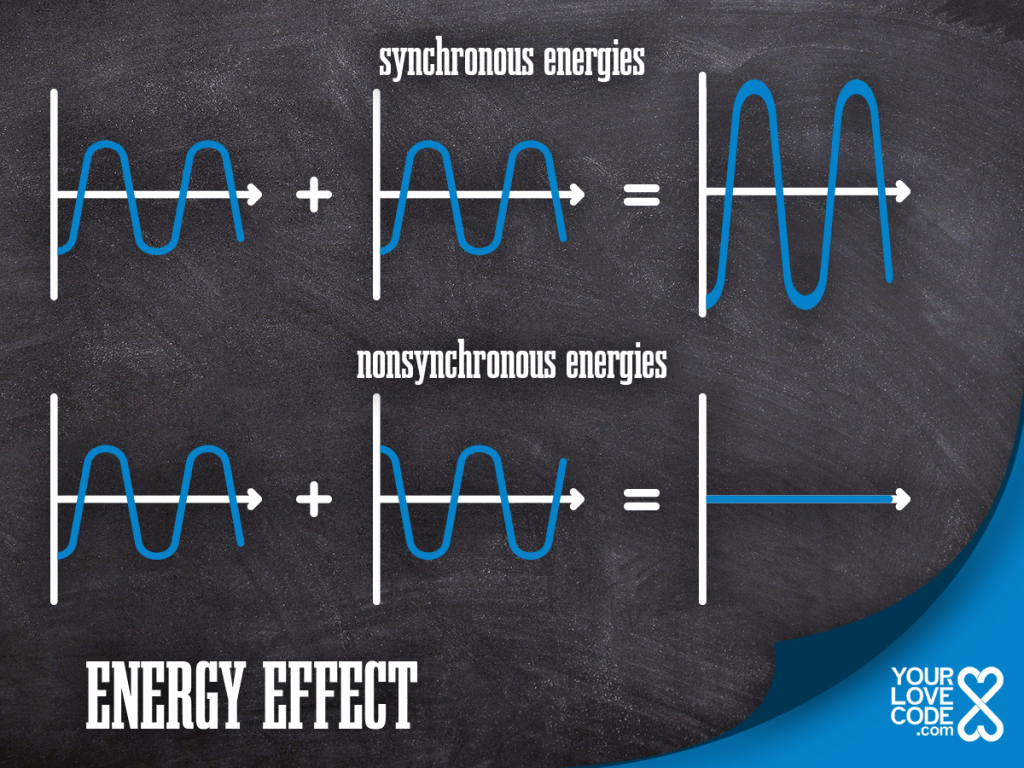
The following graphic shows the difference between synchronized and non-synchronized energies
as a visual approximation of the mechanism described by YourLoveCode as energy synchronicity.
Mechanism of Energy Synchronicity — visual representation of synchronized and non-synchronized energies.
Click the image to view it in a larger size.
Connection to the wider YourLoveCode framework
This page connects directly with the broader YourLoveCode framework.
It should be read together with the articles on Love and Quantum Physics,
The Essence of Love, Love Before Media, and Überlagerung.
Together, they describe the same question from different angles:
what connects people before the image, what the image changes,
and what remains when narrative is separated from mechanism.
Conclusion
YourLoveCode does not remove stories from relationships.
It shows that stories are not enough.
Relationships unfold through similarity, resonance, exposure, image, time and context.
Only when these layers are separated can the mechanism become visible.
June 25, 2020 / February 11, 2026
THE ORIGINATOR AND ANALYSIS RESULTS
YourLoveCode – the context of the tool’s creation and the framework for interpreting results
How to read this page
YourLoveCode did not originate as an academic project or a personal narrative.
Its source lies in personal observation, systemic analysis, and many years of testing the mechanism of similarity and synchronization in human relationships.
The first part of this page presents the context in which the tool was created and its boundaries.
The second part of this page addresses the interpretation of results in the context of the overlaying of multiple layers (superposition).
The proper meaning of the results emerges only when they are read systemically, not as a direct cause of relationships.
PART I
CONTEXT AND LIMITS OF THE TOOL (without interpretation of results)
How the idea of YourLoveCode emerged
YourLoveCode emerged as a result of long-term observation of human relationships, their dynamics, recurring patterns, and the discrepancy between how relationships are culturally represented and how they function in reality.
The starting point was not the intention to create a theory or a product, but the need to understand the mechanism responsible for why some relationships stabilize over time while others—despite intensity and involvement—fall apart.
The project developed gradually by combining personal observations with systemic analysis and by testing hypotheses in practice.
What the basic analysis and premium analysis are
The basic analysis and the premium analysis in YourLoveCode are diagnostic tools whose purpose is to identify areas of similarity and potential synchronization between individuals.
The analysis is not intended to predict relationships or to make decisions on behalf of the user.
Its function is structural description, encompassing, among other things, biological, cognitive, emotional, energetic, and structural aspects.
The premium analysis broadens the scope of observation but does not change the nature of the tool—it remains interpretative support, not a predictive instrument.
What the YourLoveCode analysis does not do
The YourLoveCode analysis:
does not guarantee a relationship,
is not the cause of contact,
does not make decisions for the user,
does not replace life dynamics, environment, or time.
It is a descriptive tool, not a causal one.
TRANSITION
The proper meaning of analysis results does not arise from numbers or descriptions alone.
It emerges only in the context of the overlaying of multiple layers: similarity, environment, narrative, life stage, and exposure.
This perspective constitutes the content of the second part of the page.
PART II
INTERPRETING RESULTS IN THE CONTEXT OF OVERLAYING (SUPERPOSITION)
Analysis results and the mechanism of overlaying
The results of the basic and premium analyses are not the cause of a relationship, nor are they its guarantee.
From the perspective of YourLoveCode, they should be understood as one of the layers that overlap in real life:
biological and cognitive similarity,
social and professional environment,
narrative and aesthetics,
life stage,
exposure and frequency of contact.
This phenomenon is referred to as superposition—in a systemic, not symbolic, sense.
Interpreting results in practice
Analysis results should be read not as an answer to the question “will a relationship happen,” but as information about potential structural resonance, which may be strengthened or weakened by other layers of the system.
Results involving the women from points 3 and 4 – the role of environment and narrative
In the case of results obtained with the women from points 3 and 4, it is crucial to distinguish between the analysis result and the dynamics of contact.
Both individuals operated within the fashion industry and, at different periods, achieved a certain level of success in their respective environments. This implies the presence of an additional layer of environmental superposition—aesthetic, social, and narrative.
From the perspective of YourLoveCode, this does not constitute evidence of relational effectiveness, but rather an example of how the overlaying mechanism operates, in which the analysis is one element of a broader whole, not its cause.
Limits and responsibility of interpretation
YourLoveCode offers no promises and no simplified conclusions.
Its aim is responsible explanation of the mechanism, not the reinforcement of illusions of control over relationships.
RESULT EXAMPLES (VISUAL)
1. 15-year relationship
Example 1: 15-year relationship – visual summary of synchronization-energy results.
2. 7-year relationship
Example 2: 7-year relationship – visual summary of synchronization-energy results.
3. 7-year infatuation
Example 3: 7-year infatuation – visual summary including 5× similarity components.
4. A date
Example 4: A date – visual summary including 5× similarity components.
CONCLUSION
YourLoveCode does not describe relationships as a simple result of analysis.
It describes relationships as a system in which results, environment, and time overlay, creating real contact dynamics.
The overlaying mechanism (superposition) is described in greater detail in the article “Überlagerung”.
The Media section presents its broader contextual and societal implications.
To provide the best experiences, we use technologies like cookies to store and/or access device information. Consenting to these technologies will allow us to process data such as browsing behavior or unique IDs on this site. Not consenting or withdrawing consent, may adversely affect certain features and functions.
Functional
Always active
The technical storage or access is strictly necessary for the legitimate purpose of enabling the use of a specific service explicitly requested by the subscriber or user, or for the sole purpose of carrying out the transmission of a communication over an electronic communications network.
Preferences
The technical storage or access is necessary for the legitimate purpose of storing preferences that are not requested by the subscriber or user.
Statistics
The technical storage or access that is used exclusively for statistical purposes.The technical storage or access that is used exclusively for anonymous statistical purposes. Without a subpoena, voluntary compliance on the part of your Internet Service Provider, or additional records from a third party, information stored or retrieved for this purpose alone cannot usually be used to identify you.
Marketing
The technical storage or access is required to create user profiles to send advertising, or to track the user on a website or across several websites for similar marketing purposes.